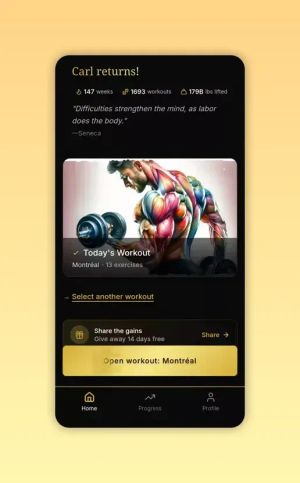
First Look: Dr. Muscle X New Features & Improvements
Train faster, track smarter, lift anywhere
Train faster, track smarter, lift anywhere
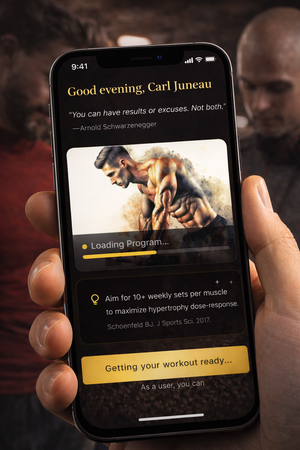
Built by an exercise scientist, updated 50+ times per year—from progressive overload to daily undulating periodization, here's what makes Dr. Muscle the smartest trainer you'll ever have

Meet Dr. Muscle X: The Future of AI Personal Training. Early Preview Now Open.

Power meets simplicity. Innovation meets iron. Right on your wrist.

No hype, no gimmick—just science-backed workouts that grow with you using AI
An honest look at MacroFactor and results from 9 users of the app: is it worth it in 2025?
Workout reminders are here! Set them up in Settings (or when you create your account) to get a notification reminding you to work out on the days and times of your choosing. Also, you can now turn deloads and challenges on and off. Simply open an exercise and tap the
The secret to building muscle is to get stronger over time. But as you work out and build strength, you also accumulate fatigue. When you accumulate too much fatigue, your progress slows down, or stalls. That's when you should deload. Dr. Muscle automates that for you, but some
Dr. Muscle is a trainer, not a tracker. But when you try the app for the first time, it may not be that obvious to you. So, with this update, as you're creating your account, we walk you through two quick demo workouts. This lets you experience how
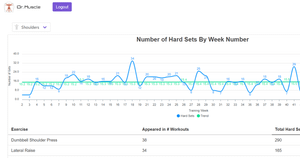
If you want to get in shape fast, it's a good idea to keep an eye on your weekly volume (best measured in number of hard sets per body part). It should be around 10-20 sets, and now you can analyze it from all angles with our new
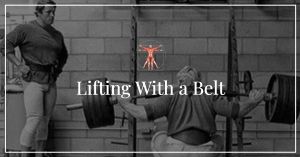
Should you lift with a belt? A client wants to know: I think that I am getting to a point where I will need a brace/belt because I am needing to be more careful to keep strain off of my knee joints (squat) and back (deadlift). What do you
Now, if you toggle off "I have a pulley" under Settings, you automatically swap out all pulley exercises from your Dr. Muscle workouts. Similar exercises (that don't require a pulley) replace them.
Goto et al. (2004) studied back-off sets. They found that lifters who did back-off sets gained more strength and endurance than those who did not. There was also a trend (p = 0.08) for more muscle gain. Good news! Dr. Muscle now automates them for you. You'll do
Our letter to the editor is out! In August, Morton et al. (2019) published a review titled Training for strength and hypertrophy: an evidence-based approach. In that paper, they argue that “load does not mediate resistance-training-induced muscular hypertrophy.” Instead, they suggest that “the most potent regulator of resistance-training-induced muscular hypertrophy
You can now log in with Google. Also: more custom tips as you create your account, improved UX/UI of workouts and menus, and 3 work sets for new exercises (up from 2).
I co-authored a review titled Mesocycle Progression in Hypertrophy: Volume Versus Intensity with Mike Israetel (Israetel et al. 2019). It was published on Dec 11. How should you progress in a mesocycle? From the abstract: “Should the trainee add more add more weight to the bar each week, add repetitions