New Study: More Muscle With Lengthened Partials Than Full ROM in Trained Lifters
Lengthened partials may boost growth in some cases. Here’s when they help, when they don’t, and how to apply them in your own hypertrophy workouts.



Key Takeaways
- Your hamstrings may grow more from lengthened partials than full range of motion (ROM) over 8 weeks.
- You should keep at least one long-length exercise for every major muscle group.
- Your final set is the best place for lengthened partials without losing progress tracking.
Try This Today
✔ Keep your first set of leg extensions, lying leg curls, or calf raises full ROM. On the final set, perform controlled lengthened partials after you can no longer complete clean full reps.
Want to build more muscle by using the part of each rep that creates the most useful tension?
In this expert review, we analyze, critique, and expand on Menno Henselmans's analysis of lengthened partials, long muscle length training, and hypertrophy.
What makes this review different?
- Carefully reviewed and fact-checked by exercise science experts.
- Practical tips to use long muscle lengths without wrecking recovery.
- A complete lower-body workout plan built around high tension in stretched positions.
Why should you listen to us? Our articles are reviewed by exercise scientists with PhDs from top universities and 60+ years of combined training experience. We combine serious academic credentials with decades of practical training experience to give you science-backed advice you can trust. We've published 300+ articles so far.
Keep reading to learn when lengthened partials can improve your physique and when full ROM should remain the foundation.
Related:
- Ultimate List of the Best Hypertrophy Training Methods to Build Muscle Fast
- An Up-to-Date Look at the Science of Rep Ranges for Muscle Hypertrophy
- Your Comprehensive, Practical, Evidence-Based Guide to Hypertrophy Training
In a Nutshell: Lengthened Partials for Hypertrophy
You do not need to throw away full ROM training. Full ROM remains your best base because it lets you train a muscle through a useful range while keeping your performance easy to measure.
You should make sure each muscle has at least one exercise that loads it well at a long muscle length. For hamstrings, leg extensions, and calves, lengthened partials may offer extra stimulus when the bottom portion can handle far more tension than the top.
You can use full ROM first and add lengthened partials only at the end of the last set. That keeps your training hard, measurable, and productive. Small smart changes add up.
Key Concepts
- Lengthened partials: Partial reps performed in the stretched portion of an exercise.
- Mechanical tension: The main growth stimulus created when muscle fibers work hard against resistance.
- Length-tension relationship: Muscles produce different amounts of force at different lengths.
Long Lengths Matter, But They Are Not Magic
Lengthened partials had a fast rise in popularity. The idea is simple: instead of doing a full repetition, you spend your reps in the bottom, stretched segment of the lift. Think the lower half of a leg extension, the bottom of a calf raise, or the stretched part of a lying leg curl.
At first, several findings suggested that this approach could build more muscle than full ROM. Then studies in trained lifters did not consistently reproduce that result. This led to the argument that long-length training mainly made muscles longer in beginners, rather than appreciably thicker in a way that would keep improving an experienced lifter's physique.
That explanation rests on sarcomerogenesis in series. In plain English, the muscle may add length. Since a muscle attaches between bones, however, this potential is limited. It cannot continue forever.
There is another explanation for why trained lifters often show smaller effects. They simply gain less muscle over a typical eight-week experiment. When the amount of growth is small, it is harder to detect meaningful differences between two solid programs.
The First New Finding in Trained Lifters
A new preprint helps change the discussion. Strength-trained men followed a lower-body program for eight weeks using either full ROM or lengthened partials. The program used leg presses, leg extensions, and lying leg curls.
The lengthened-partial group showed significantly greater growth in the semitendinosus, a hamstring muscle. The researchers measured this with MRI, which is a very strong way to assess changes in muscle size. Total hamstring growth also favored lengthened partials, although it narrowly missed the usual threshold for statistical significance with a p value of 0.058.
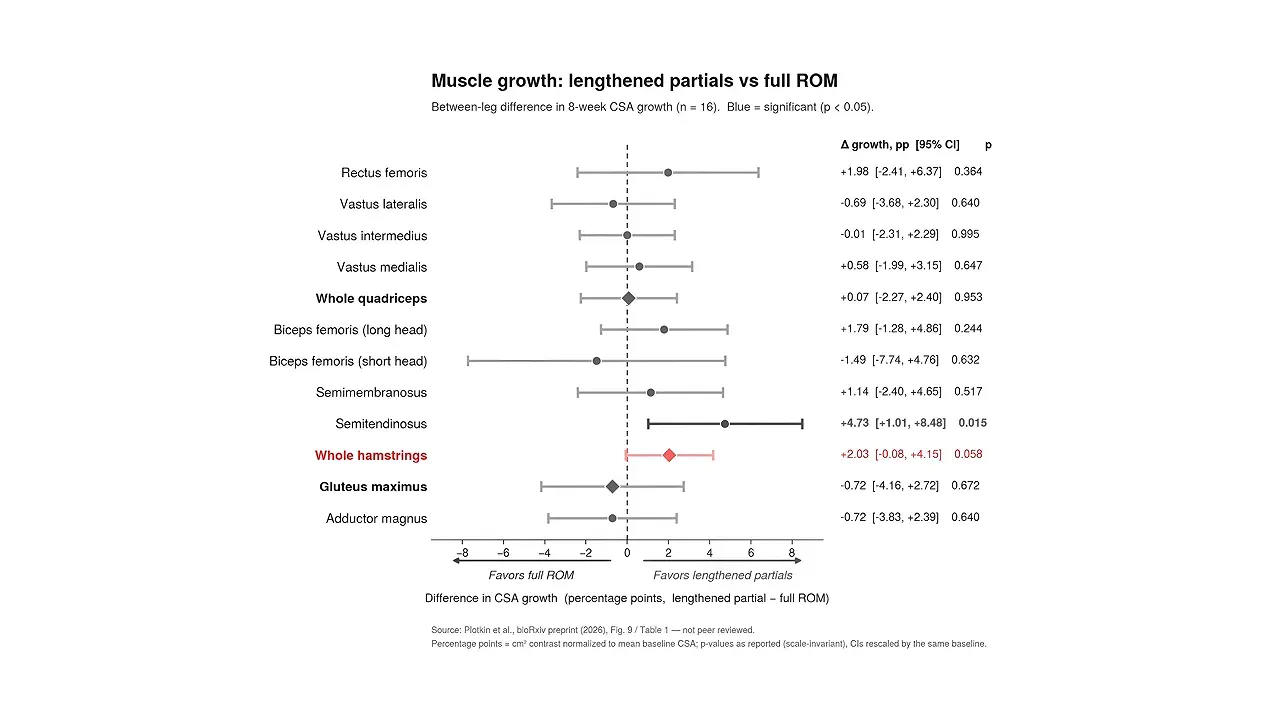
This result is difficult to explain as simple muscle lengthening. These were trained people, and lying leg curls do not create an extreme hamstring stretch. The finding makes a better case that long-length partials can create actual hypertrophy in a trained population.
Still, do not go all in. The study did not find significant growth advantages for the other muscle groups. Quadriceps signaling and biopsy data also did not show a clear advantage for lengthened partials.
Why Hamstrings May Have Won
The best explanation is specific to exercise selection. Standard lying leg curls do not train the hamstrings at long muscle lengths very well. Using the lower portion of the rep may give the hamstrings a new stimulus they were otherwise missing.
The quadriceps situation was different. Participants performed very deep leg presses. Deep leg presses already train the quads at long lengths. Adding lengthened partials to this may provide little extra value because the important box was already checked.
This gives you a better rule than “longer is always better.” Ask whether your present program already loads a muscle hard in its stretched position. If it does, more long-length work may add little. If it does not, you may be leaving useful gains on the table.
Active and Passive Tension
Muscle growth comes from mechanical tension. That tension has active and passive components. Active tension comes from muscle fibers contracting. Passive tension rises when a muscle is stretched under load.
Different muscles and lifts have different length-tension relationships. Some muscles produce high force when stretched. Others lose too much active force as they get longer, and the extra passive tension may not fully compensate.
This helps explain why hip thrusts and squats can produce similar glute growth. Hip thrusts likely provide more active tension in their strongest range. Squats offer a greater long-length position and more passive tension. Either route can deliver enough total tension for growth.
What the Partial-Rep Studies Actually Tell You
Lengthened Partials Beat Shortened Partials
The second study used non-strength-trained participants and compared three lower-body approaches over eight weeks. Every group did 3 to 4 sets of 8 to 10 reps.
- Full ROM: 0 to 90 degrees of knee flexion at 80% of the 1RM for that range.
- Shortened partials: 0 to 50 degrees, focusing on the contracted portion, also at 80% intensity.
- Lengthened partials: 40 to 90 degrees, focusing on the lower portion, at 55% intensity.
The lower load in the lengthened-partial condition was selected to equalize estimated mechanical tension. The key question was whether stretched-position partials could still outperform shortened-position partials when total tension was supposedly matched.
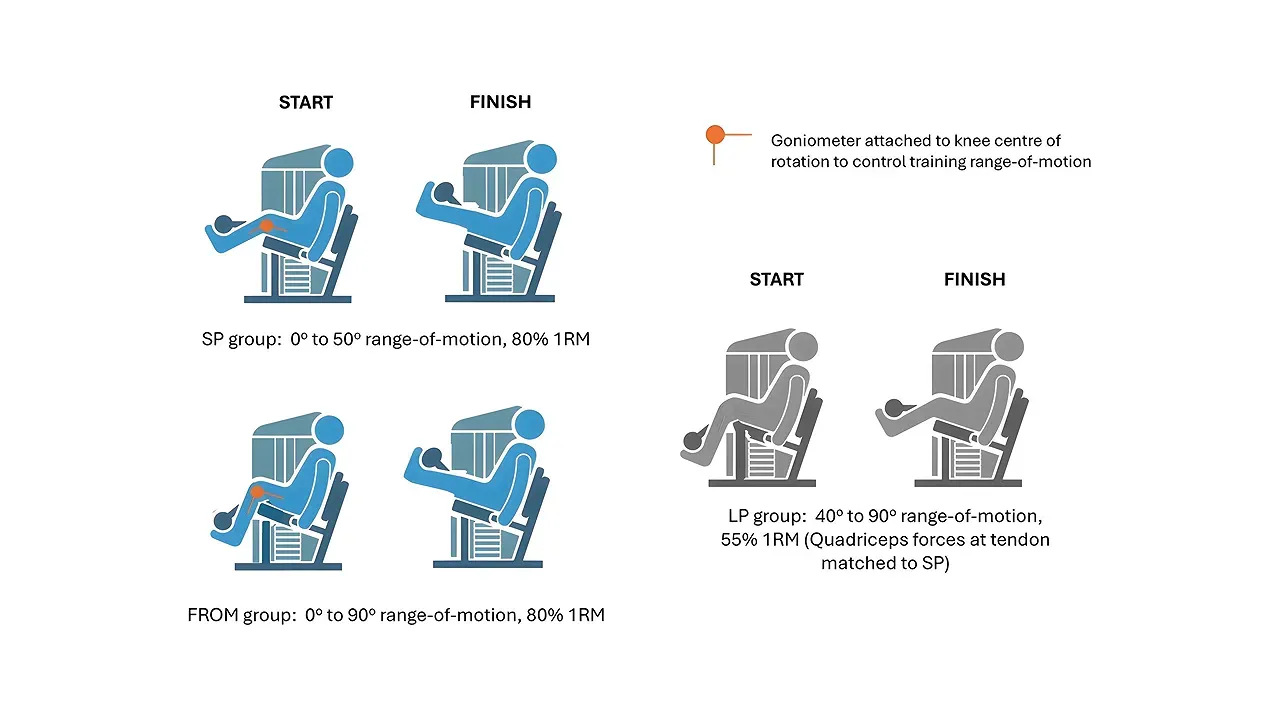
They did. Lengthened partials produced significantly more growth than shortened partials at two of the three measured sites. More interesting, the lower-load lengthened partials produced muscle growth similar to full ROM, despite the estimate of less overall quadriceps tension.
The researchers suggested that the additional hypertrophy came from passive tension at long muscle lengths. That is an interesting idea. But it would be a big leap to conclude that muscle growth has an established driver beyond mechanical tension.
Three Important Caveats
First, the study estimated total quadriceps tendon force. That is not identical to the actual tension in the vastus lateralis, where hypertrophy was measured. Dynamic contractions also change muscle shape and pennation angle, which makes force estimates less exact.
Second, proximity to failure was not clearly established. Some people in the lengthened-partial group found the work harder than expected. If they were training closer to failure, their actual stimulus may have been greater than the calculations suggested.
Third, these were untrained people and their muscle fascicle length increased. Some of the added size may therefore reflect muscle lengthening, not just thickening. That does not make the results useless. It does mean you should be cautious about assuming the same magnitude of benefit in trained lifters.
How Long Is Long Enough for Biceps?
The third study gives the most important reality check. Participants trained Bayesian cable curls for ten weeks. One group kept the elbow at the side. The other let the elbow travel far behind the body to stretch the biceps more.
Both groups gained roughly 6% to 9% in elbow-flexor size. There was no meaningful difference between them. More stretch did not produce more muscle.
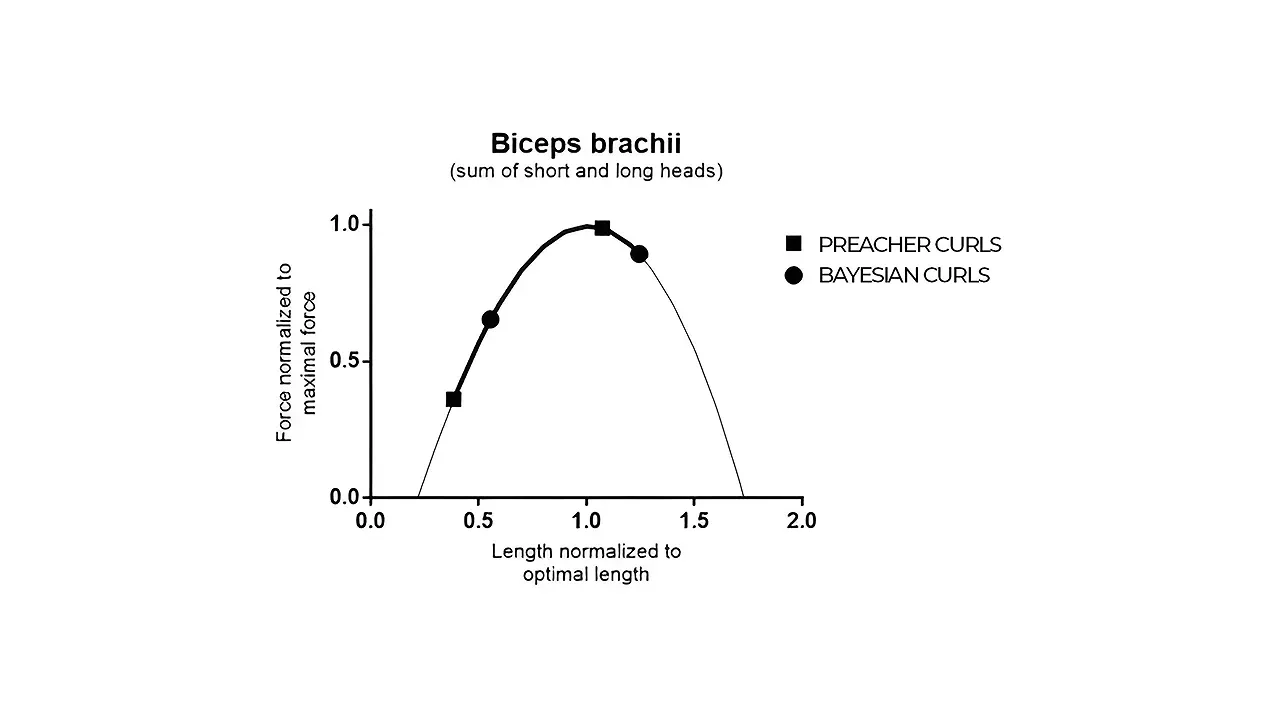
This is exactly what you would expect from the biceps length-tension relationship. A regular dumbbell or barbell curl provides almost no meaningful resistance at the bottom because gravity pulls straight down. The cable setup fixes that weakness by loading the biceps when the elbow is near your side.
But pulling the elbow far behind the body can reduce active tension. The biceps may be more stretched, yet not working harder. You need a long muscle length and high tension. Stretch alone is not a hypertrophy program.
Why You Should Not Max Out Long-Length Training
The evidence is encouraging because lengthened partials generally show either neutral or positive effects. There is no strong indication that they are inherently harmful. But that does not mean you should do every set as a stretched-position partial.
First, fatigue and injury risk are highly specific to joint angle and movement. If you load all your weekly volume into one stretched joint position, you concentrate stress on one vector. Your total volume tolerance may drop, especially when you pile it onto muscles and joints that are already beat up.
Second, partial reps are harder to track. If you do a bench press, squat, or chin-up to a clear standard, you either complete the rep or you do not. With a partial, it is easy to quietly cut an inch off the range to get another rep.
That creates a slippery slope. If you cannot tell whether your range is changing, you cannot tell whether you are stronger. Use reference sets or a similarly consistent full-ROM benchmark to keep your progression honest.
Use Long Lengths With Precision
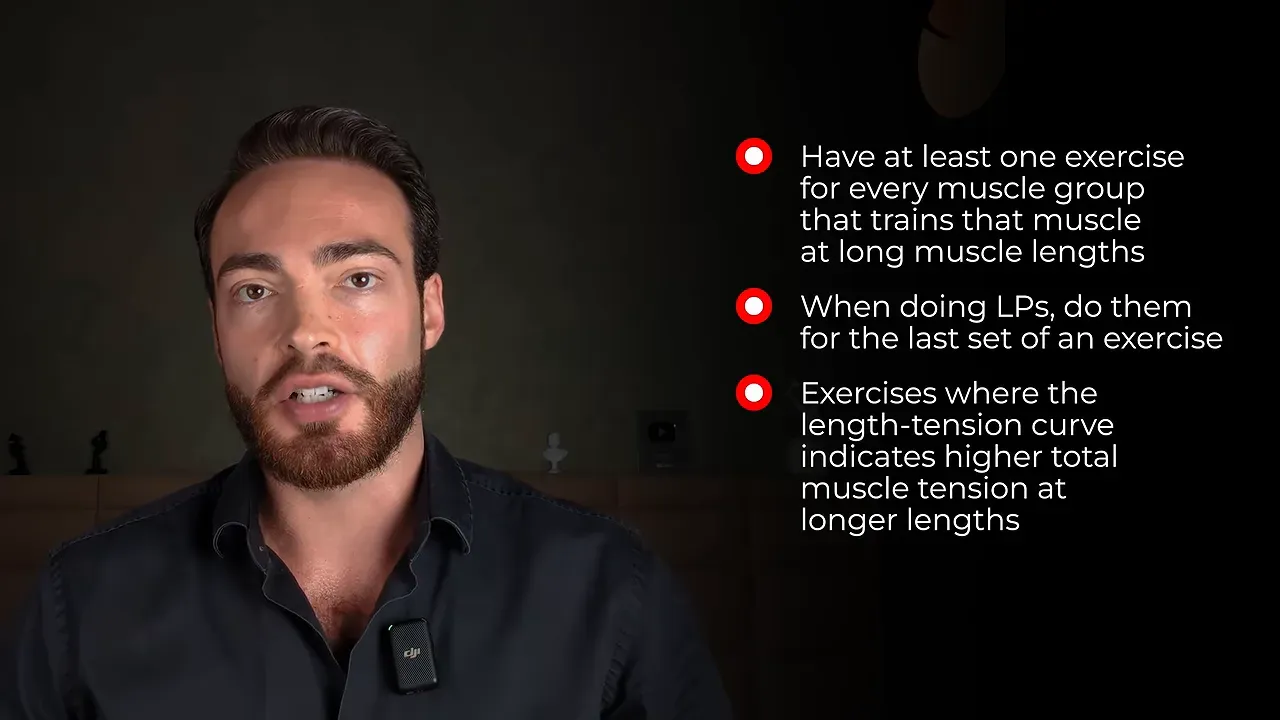
The practical conclusion is not complicated. Make sure every major muscle group has at least one exercise that trains it well at a long muscle length. Most lifters are still doing incomplete reps and avoiding the stretched position, so this alone can improve their results.
Full ROM beats shortened ROM largely because it exposes muscles to longer lengths. The benefit is not simply about moving a joint through the greatest possible distance. It is about producing tension where the muscle is long.
Use Lengthened Partials at the End
Start with full ROM. It gives you a clean benchmark for strength and performance. Then, on the final set or final sets, add lengthened partials once you cannot complete another full rep with the same standard.
This is especially useful for exercises where you can do many more reps by avoiding the shortened range. Good candidates include:
- Leg extensions
- Lying leg curls
- Standing or seated calf raises
In calf raises, the bottom position can generate high active and passive force. If your set ends because you cannot get all the way to the top, you may still have substantial productive capacity in the lower range. Lengthened partials let you use it.
Do not confuse this with an excuse to bounce through the bottom. Keep the movement controlled. Keep the range consistent. Add partials only when they solve a clear problem in the resistance curve.
Long-Length Lower Body Plan
This short lower-body plan is based on the core insight that you should train each muscle hard at a useful long length while still preserving full-ROM progression.
Program Overview
- Ideal for: Intermediate lifters who want more leg muscle with manageable fatigue.
- Equipment needed: Leg press, leg extension, lying leg curl, calf raise machine, and a squat setup.
- Frequency: Two lower-body sessions per week with at least 2 days between them.
- Progression: Add reps first while keeping the same range, then add load when you reach the top of the rep range.
Workout
- Use full ROM on all initial work sets.
- Reserve lengthened partials for the final set of selected isolation lifts.
- Keep one to three reps in reserve on most compound sets.
- Rest long enough to maintain output. For most hypertrophy work, at least 2 minutes is a practical target.
Day 1: Quad and Calf Focus
| Exercises | Sets | Reps | Rest |
|---|---|---|---|
| Deep Leg Press | 3 | 8 to 10 | 2 to 3 minutes |
| Leg Extension | 3 | 8 to 12 plus lengthened partials on last set | 2 minutes |
| Standing Calf Raise | 3 | 10 to 15 plus lengthened partials on last set | 90 to 120 seconds |
| Split Squat | 2 | 8 to 12 | 2 minutes |
Pro Tips
- Use a deep leg press range only if you can maintain a stable pelvis and repeat it consistently.
- On leg extensions, make your full-ROM reps your reference. Only then add lower-range partials.
- Pause briefly in the stretched calf position instead of rushing out of it.
Day 2: Hamstring and Glute Focus
| Exercises | Sets | Reps | Rest |
|---|---|---|---|
| Romanian Deadlift | 3 | 6 to 10 | 2 to 3 minutes |
| Lying Leg Curl | 3 | 8 to 12 plus lengthened partials on last set | 2 minutes |
| Squat | 3 | 6 to 10 | 2 to 3 minutes |
| Seated Calf Raise | 3 | 10 to 15 plus lengthened partials on last set | 90 to 120 seconds |
Pro Tips
- Use the lying leg curl to give the hamstrings a more deliberate long-length stimulus.
- Do not add partials to every set. One hard final set is plenty to start.
- Track reps and load on the full-ROM work before judging whether the plan works.
Notes on Program Execution
- Use the same machine setup and range each week.
- Stop adding lengthened partials if they reduce performance in later sessions or cause excessive soreness.
- Keep weekly volume sustainable. More work is not better when recovery falls apart.
- Consider your rest periods seriously. Longer rests can help you preserve quality performance, as explained in this guide to rest between sets.
Want to automate workouts like that and more? Put your progress on autopilot with Dr. Muscle AI.
Expert Corner: Proven Strategies & Hidden Gems
Practical Applications
- Audit your current exercise menu. List each major muscle group and identify one lift that loads it meaningfully while long. If your hamstrings only get shallow curls and your quads only get shallow leg presses, the issue is not your supplement stack. It is your exercise execution.
- Use full ROM as your control condition. For 2 to 4 weeks, record the load and number of clean full-ROM reps on your first working set. This gives you a reliable signal before you add stretched-position fatigue.
- Add partials where the resistance curve supports them. Leg extensions, lying leg curls, and calf raises are sensible starting points because the lower range can retain high tension while the top range limits the set.
- Limit the dose. Start with one final-set partial sequence per exercise, once or twice weekly. Monitor whether your full-ROM reference performance continues to improve.
- Manage recovery as part of the method. Long-length work can be demanding. If soreness, joint discomfort, or performance decline accumulates, reduce partials before adding more volume. Your maximum recoverable training volume is individual and changes with life stress.
Examples:
- After 10 clean leg extensions, perform 4 to 6 controlled lower-half reps rather than forcing ugly lockout reps.
- After a full-ROM calf raise set ends at 12 reps, continue with 5 to 8 strict bottom-range reps while keeping the stretched position consistent.
More Little-Known Tips for Lengthened Partials
- Use a repeatable visual landmark. On leg extensions, your shin reaching horizontal can help standardize your full-ROM target.
- Do not turn every hard set into failure training. The partials are an extension of productive work, not a contest to see how distorted the rep can become.
- Use machines when learning the method. They make range, loading, and setup easier to repeat than free-weight partials.
- Keep the eccentric controlled. A rushed descent can make the stretched position feel productive while reducing consistency and increasing fatigue.
- Rotate the emphasis only when needed. You can run full ROM as your base and use partials in focused blocks rather than making them permanent on every lift.
Common Mistakes With Lengthened Partials & How to Fix Them
- Replacing all full-ROM work: Keep at least your first working set full ROM so you can assess strength changes.
- Using partials on a poor exercise match: Do not assume a deeper stretch equals a better result. Choose movements that maintain substantial tension in the lengthened range.
- Changing range every session: Set clear start and end points, then keep them stable for several weeks.
- Adding too much volume: Start with one partial-rep finisher per target exercise, not partials on every work set.
- Ignoring declining performance: If your full-ROM reps or loads fall week to week, cut back the partials and restore recovery.
My Opinion on Lengthened Partials
I think lengthened partials are useful, but I think their popularity has made some people lose the plot. The goal is not to find the most uncomfortable inch of every exercise (and boy can they be painful).
No. As you may remember, the goal is to create enough high mechanical tension and fatigue to build more muscle.
I disagree with the “full ROM is obsolete” camp. Full ROM is still the easiest way to make performance honest. You can track a squat, chin-up, bench press, or leg extension with a clear range. That matters more than people think.
I also disagree with the claim that stretched training is only an illusion from longer muscle fascicles. The trained-lifter hamstring result gives that criticism a real problem. But one meaningful finding in semitendinosus does not mean every muscle needs a stretched-partial-only program.
I would use partials as a specialty tool. I would apply them to lying leg curls, leg extensions, and calf raises, then watch the numbers. If your full-ROM performance rises, recovery stays good, and your physique improves, keep them. If not, do less.
Concluding on Long-Length Training
Long muscle length training has earned a place in hypertrophy programming. The emerging evidence supports the idea that, in the right exercise, loading a muscle in a stretched position can produce more growth or at least match full ROM with less load.
The strongest lesson is more precise than the social-media version. Muscles do not grow simply because they are stretched. They grow when they experience high tension, and long lengths can sometimes raise that tension through a combination of active and passive forces.
You should retain full ROM as your foundation, use at least one long-length exercise per muscle group, and apply lengthened partials mainly on final sets where they have a clear mechanical purpose. This gives you a more muscular physique without making your training impossible to track.
If you want this process handled for you, Try Dr. Muscle AI—it's free. It automates progressive overload, workout adjustments, volume management, and more, so you can focus on putting in the work.
FAQ
Do Lengthened Partials Build More Muscle Than Full ROM?
Lengthened partials can build more muscle than full ROM in certain contexts, but they do not consistently outperform full ROM for every muscle or exercise. In trained lifters, an eight-week lower-body program found greater semitendinosus growth with lengthened partials, while other measured muscles did not show a clear advantage.
What Are Lengthened Partials?
Lengthened partials are partial repetitions done in the stretched portion of an exercise. For example, you might perform the lower half of a leg extension, lying leg curl, or calf raise after completing your clean full-ROM reps.
Should You Do Lengthened Partials on Every Set?
You should not do lengthened partials on every set. Keep your first set full ROM to track your strength, then use lengthened partials on the final set if the exercise loads the muscle well in the stretched position.
Which Exercises Are Best for Lengthened Partials?
Lengthened partials are especially useful for leg extensions, lying leg curls, and calf raises because you can often perform more work in the bottom range than at full lockout. These lifts can maintain high tension at longer muscle lengths.
Are Lengthened Partials Better for Biceps?
Lengthened partials are not automatically better for biceps. Bayesian cable curls already load the biceps well with the elbow near your side, while letting the elbow drift far behind your torso may reduce active tension and did not produce more growth in the ten-week comparison described here.
Final Note
Use lengthened partials to improve a well-built program, not replace one. Keep your ranges honest, train hard at useful muscle lengths, and let Dr. Muscle AI automate the progression, volume changes, and workout planning that support more muscle and an improved physique.