Train More Often, Grow More? What 67 Studies Say About Training Frequency
I train up to 14 times a week—here's why spreading your sets out helps you do more work, and how to use it without burning out

Key Takeaways
- If your weekly sets are the same, training a muscle 2, 3, or 4 times a week gives about the same growth.
- The real win: more sessions make it easier to do more sets. More sets build more muscle.
- Start by spreading the sets you already do. Then add a little, if you recover well.
Try This Today
✔ Pick one muscle you train with 10 sets a week. Keep the 10 sets, but split them over three sessions: 4, 3, and 3. Log your reps and effort for two weeks before you add more.
Want to build more muscle without making every workout longer?
In this expert review, we analyze, critique, and expand on House of Hypertrophy‘s breakdown of training frequency, weekly sets, and muscle growth.
What makes this review different?
- We add the newest studies on splitting one workout into two.
- We show you how to use extra sessions to add sets without wrecking your recovery.
- You get a full workout plan that spreads your sets out first, then adds more.
Why should you listen to us? Our articles are reviewed by exercise scientists with PhDs from top universities and 60+ years of combined training experience. We’ve published 300+ articles so far.
Keep reading to find the training frequency that helps you do more good work, recover, and build a better body.
Related:
- How Often Should You Train for Hypertrophy?
- Ultimate List of the Best Hypertrophy Training Methods to Build Muscle Fast
- Your Comprehensive, Practical, Evidence-Based Guide to Hypertrophy Training
In a Nutshell: Training Frequency for Muscle Growth
There’s no magic number of training days. If your weekly sets stay the same, different frequencies give about the same growth.
But frequency is a great tool. Going from two sessions of 5 chest sets to three sessions of 4 takes you from 10 to 12 sets a week. And each session gets shorter.
So if you have the time and want the best results you can get, train more often. Spread your sets first. Then add a little at a time.
Key Concepts
- Muscle training frequency: How often you train a muscle, not how often you go to the gym.
- Weekly training volume: How many hard sets you do for a muscle in a week.
- Split sessions: Breaking your training into shorter bouts, on different days or on the same day.
Same Weekly Sets, Similar Muscle Growth
You can train five days a week and hit your chest only once. Or you can train three days a week and hit it every time. The second plan trains your chest more often, even with fewer gym visits.
A body-part split often trains each muscle once a week. An upper/lower split usually trains each muscle twice. A three-day full-body plan trains each muscle three times.
But those labels don’t tell you much. You still need to know how many sets you do, how hard they are, and whether you recover.
What the New Analysis Compared
The meta-regression discussed in the video looked at frequency and muscle growth in 35 studies with more than 1,000 people. It has since been published in Sports Medicine. The key rule: weekly sets had to be equal.
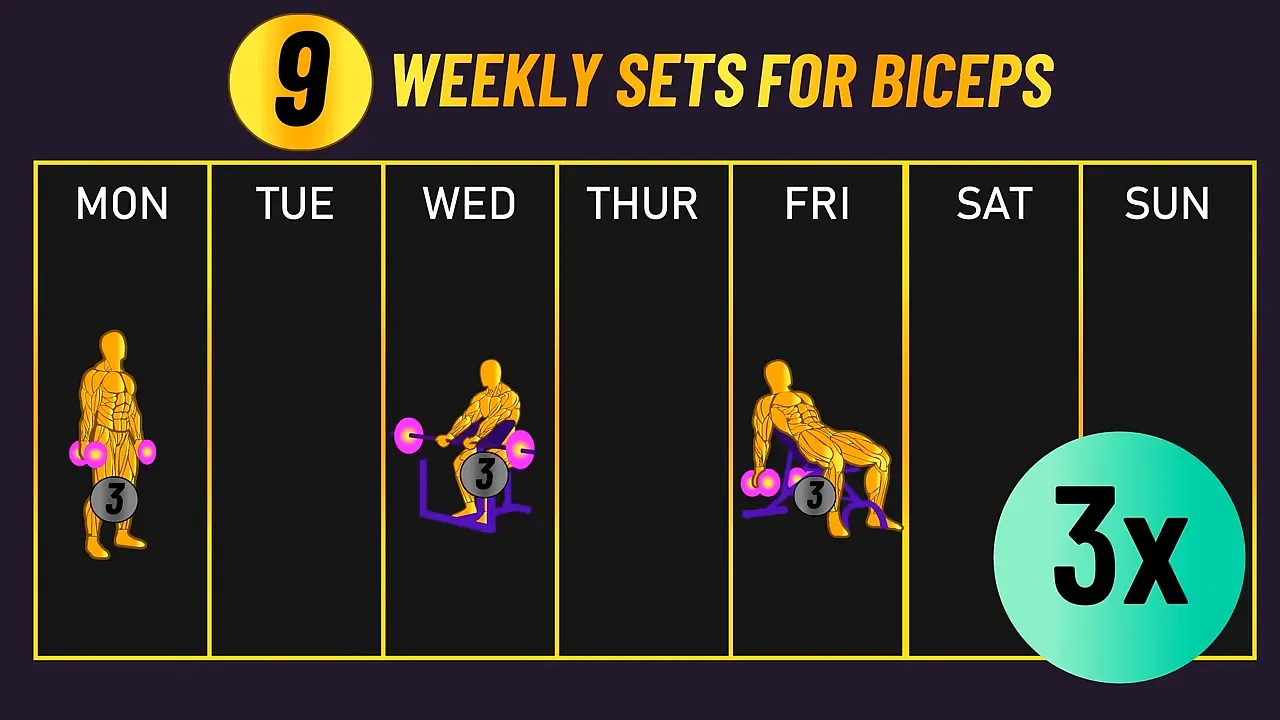
Say you do 9 biceps sets a week. You could do all 9 on Monday. Or you could do 3 on Monday, 3 on Wednesday, and 3 on Friday.
Both plans have 9 sets. That’s how you test frequency on its own. If the second plan had 15 sets, you’d be changing two things at once.
In most studies, people took their sets to failure or close to it. They also changed the weight to stay in their rep range.
That matters. By set 8 of a long biceps workout, you may need lighter dumbbells to hit 8 to 12 reps. Spread over three short workouts, you start fresh and can use heavier weights.
That sounds like a clear win for training more often. But a good reason isn’t the same as proof.
What the Results Showed
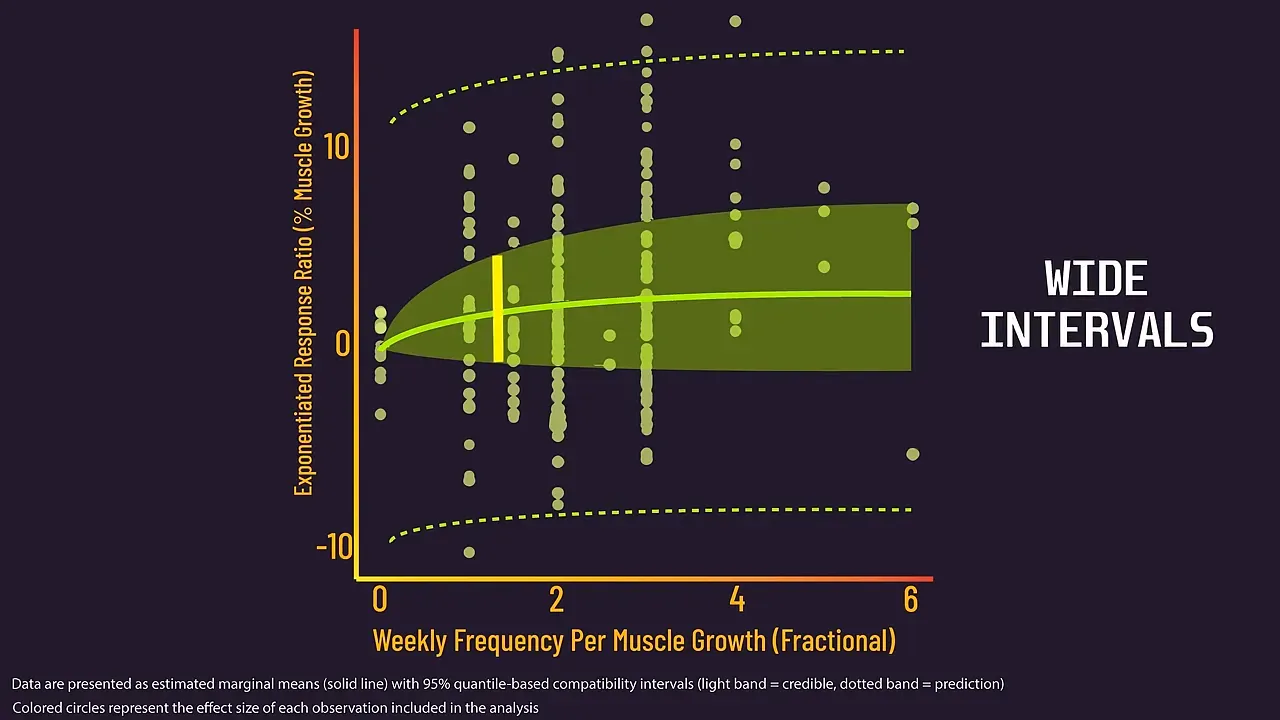
When weekly sets were equal, training more often didn’t give a clear, large boost in growth.
Growth went up a little from once to twice a week. But the margin of error was wide enough that the effect could be close to zero. Going above twice a week showed no clear extra gain.
That doesn’t mean every schedule is the same. It means you can’t expect more muscle just from adding days.
Two more findings stand out. First, the results were about the same for new and trained lifters. Second, training more often was linked to bigger strength gains. Full-body and split plans both work.
Count the Work Your Arms Already Get
Your biceps work when you row. Your triceps work when you press. Those lifts aren’t arm exercises, but they still count for something.
The researchers tried three ways to count frequency:
- Total: Count direct and indirect work the same.
- Fractional: Count indirect work as half.
- Direct: Count only exercises that target the muscle.
Say you row on Monday and curl on Thursday. For your biceps, that’s 2 sessions with the total method, 1.5 with the fractional method, and 1 with the direct method.
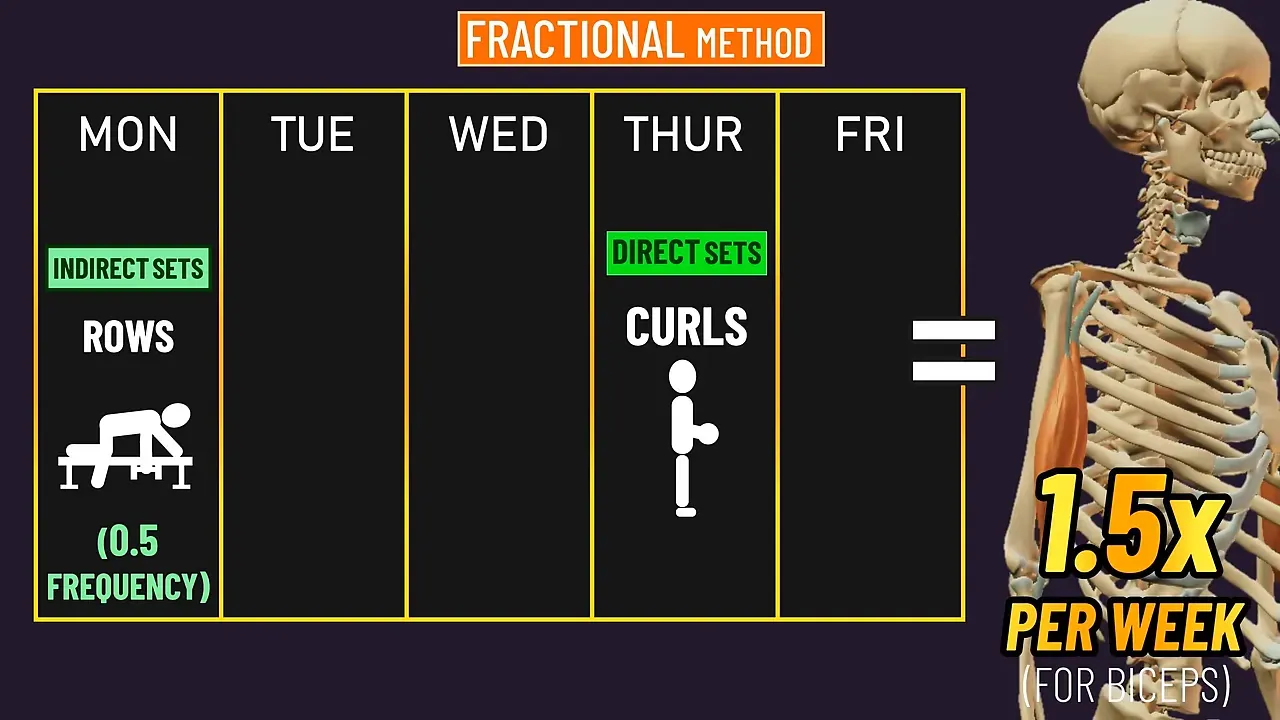
The fractional method fit the data best. So when you plan, count your overlap.
But don’t take it too literally. A row doesn’t give your biceps exactly half of what a curl does. Use it to plan, not as an exact measure.
Use Frequency to Do More Work, Not to Hit a Number
Recovery Limits Aren’t Hard Set Caps
The analysis also checked whether frequency mattered more at volumes you can or can’t recover from.
To count as “recoverable,” you could do no more than:
- 3 sets per muscle per session when training it three times a week.
- 5 sets per muscle per session when training it twice a week.
- 12 sets per muscle when training it once a week.
Neither group showed a clear, large benefit from training more often. But these side analyses were weaker than the main one.
More important, those cutoffs are labels for sorting studies. They aren’t hard limits for your body.
The video gives good examples. Trained lifters kept their performance over four days in a row with 4 chest and quad sets per session. In another study, many lifters recovered from 7 sets within 72 hours. Another group repeated a 12-set chest workout after about 72 hours.
Longer programs also showed steady weight gains with 6 quad sets three times a week, and with 11 quad sets twice a week. You can read the studies by McLester and colleagues, Miranda and colleagues, Rønnestad and colleagues, and Enes and colleagues.
These examples show what can work. They don’t promise you’ll recover on the same schedule.
The Question Equal-Volume Studies Leave Open
Here’s the key point. One question is: do you grow more if you split the same work differently? Another is: does splitting your work help you do more of it over time?
Those are two very different questions. And the second one is where frequency shines.
In a nine-week leg-press study by Neves and colleagues, each man trained one leg once a week and the other leg three times a week. Both legs did 9 sets. When the weights were free to change, the leg trained three times a week lifted about 20% more total weight. Both legs grew, and the growth gap was too small to call.
The big analysis backs this up. In the same analysis, more weekly sets meant more muscle and strength. Each extra set added a bit less than the one before, but it still added.
So here’s how we read it. More sessions make it easier to do more sets. More sets build more muscle. Here’s a chest example:
- Now: 2 sessions × 5 sets = 10 sets a week.
- Next step: 3 sessions × 4 sets = 12 sets a week.
That’s 20% more sets, with one fewer set each session. I think you’ll agree: three sessions of 4 sounds easier than two sessions of 5. It won’t give you 20% more muscle. But those 2 extra sets should help, as long as you recover.
Spread your 10 sets first. Then try 12. That way you know the shorter sessions work for you before you add more.
What About Training Twice in One Day?
Three studies looked at splitting one workout into two sessions on the same day.
In a study by Pedersen and colleagues, 23 women who lifted did the same leg workout two ways: all in one visit, or split into two halves 3½ to 5 hours apart. With the split, they did about 3% more reps (169 vs. 164). They also rated it as less effort and less discomfort.
In a bench-press study by Bartolomei and colleagues, trained men did 8 sets of 10 reps, either all at once or as two blocks of 4 sets, 4 hours apart. The split group lifted heavier and got their pressing power back faster.
In an eight-week trial by Corrêa and colleagues, trained men worked each muscle once or twice on a training day. The twice-a-day group raised its squat max by 16.1%. The once-a-day group gained 7.8%. Muscle growth was about the same in both groups.
But keep the full picture. These studies are small and short. And in the Pedersen study, 22 of the 23 women still preferred one long session. Some didn’t want a second trip. Others liked finishing one hard workout. If your gym is 30 minutes away, a second session may not be worth the drive. If you train at home, it’s a lot easier.
Choose a Schedule You Can Repeat
Start with a schedule that fits your life. Twice a week per muscle is a good starting point.
If you love long workouts and you’re still making progress, keep them. If your last sets keep getting weaker, spread them out. Let your logbook and your recovery tell you what to do next.
Three-Day Split-Session Muscle Plan
This plan uses the ideas above: spread your sets first, and split sessions if you can. It’s an example to get you started, not a tested program.
Program Overview
- Ideal for: Lifters who know the exercises and want to try shorter sessions.
- Equipment needed: Dumbbells, a bench, cables, and common gym machines.
- Schedule: Monday, Wednesday, and Friday. You can split each day into two short sessions.
- Starting effort: Stop most sets with about 2 good reps left.
- First goal: Keep your weekly sets the same while you test the new schedule.
Workout
- Do each day’s exercises in one session if that’s easier.
- To try split sessions, do the first three exercises in the morning and the rest later in the day.
- Keep the same total sets either way.
- Cut the sets if this is more than you can handle right now.
Monday: Press, Row, and Quads
- Bench press: 3 sets of 8 to 12 reps; rest 2 to 3 minutes.
- Chest-supported row: 3 sets of 8 to 12 reps; rest 2 minutes.
- Leg press: 3 sets of 8 to 12 reps; rest 2 to 3 minutes.
- Leg curl: 2 sets of 10 to 15 reps; rest 90 seconds.
- Lateral raise: 2 sets of 12 to 20 reps; rest 60 to 90 seconds.
- Calf raise: 2 sets of 10 to 15 reps; rest 90 seconds.
Pro Tips
- Do warm-up sets before your first hard lift in each session.
- Don’t add extra sets just because a short session leaves you feeling fresh.
Wednesday: Incline Press and Posterior Chain
- Incline dumbbell press: 3 sets of 8 to 12 reps; rest 2 minutes.
- Lat pulldown: 3 sets of 8 to 12 reps; rest 2 minutes.
- Romanian deadlift: 2 sets of 8 to 10 reps; rest 2 to 3 minutes.
- Leg extension: 3 sets of 10 to 15 reps; rest 90 seconds.
- Biceps curl: 2 sets of 10 to 15 reps; rest 90 seconds.
- Triceps extension: 2 sets of 10 to 15 reps; rest 90 seconds.
Pro Tips
- Keep your setup the same each time, so you can compare your numbers.
- Remember that presses and rows also work your arms.
Friday: Full-Body Repeat
- Machine chest press: 4 sets of 8 to 12 reps; rest 2 minutes.
- Cable row: 3 sets of 8 to 12 reps; rest 2 minutes.
- Leg press: 3 sets of 10 to 15 reps; rest 2 to 3 minutes.
- Leg curl: 2 sets of 10 to 15 reps; rest 90 seconds.
- Lateral raise: 2 sets of 12 to 20 reps; rest 60 to 90 seconds.
- Calf raise: 2 sets of 10 to 15 reps; rest 90 seconds.
Pro Tips
- That’s 10 chest sets a week, spread as 3, 3, and 4.
- When you’re ready for 12, add one set on Monday and one on Wednesday.
Notes on Program Execution
- Log the weight, reps, sets, and reps left for each exercise.
- Add weight when you reach the top of your rep range at the planned effort.
- Keep your sets the same at first. Don’t change frequency, sets, and effort all at once.
- If your numbers keep dropping, cut the extra sets or rest more.
Want to automate workouts like that and more? Put your progress on autopilot with Dr. Muscle AI, which personalizes your training and progression.
Expert Corner: Proven Strategies & Hidden Gems
Practical Applications
- Spread first, add later. Move your 10 weekly sets into three sessions without adding any. Once that feels good, add 1 or 2 sets a week.
- Track your time, too. A split that adds reps but doubles your travel time may not last. Note how long each session takes and whether you actually do the second one.
- Watch the overlap. More pressing means more work for your chest, shoulders, and triceps. Don’t add direct sets for all three at once.
- Count each muscle. Six sessions a week doesn’t mean six sessions for every muscle. Track each muscle on its own.
Examples:
- You move 12 weekly quad sets from two sessions of 6 to three sessions of 4. Same sets, less fatigue per session.
- You move curls from the end of a long workout to a short session later in the day. Same sets, fresher arms.
Fact-Check of Key Points
- “There’s no consistent or large effect of frequency”: True for muscle growth when sets are equal. But it doesn’t rule out small benefits, and the same analysis found more strength with more frequent training.
- “The fractional method performed the best in explaining the data”: True within this analysis. It doesn’t prove every indirect exercise gives exactly half the stimulus.
- “Suggesting the capacity to recover in 24 hours from four sets”: Possible, based on the performance data. But performance alone can’t show that every part of your body has fully recovered.
- “At worst, training a muscle more frequently has a neutral average effect”: For growth, on average, yes. But more sessions can cost you time, and for some people, joint stress.
The older idea that twice a week always beats once a week also needs care. An earlier review by Schoenfeld and colleagues favored twice a week. The newer analysis is less certain when sets are equal. Twice a week is still a smart default, not a must.
More Little-Known Tips for Shorter Workouts
Know your volume types. Going from 10 to 12 sets raises your set volume. Adding reps or weight raises your volume load, without adding sets. The 3% gain in the Pedersen study was in total reps, not in muscle.
Fresh sets aren’t the only sets that count. A lighter set taken close to failure still builds muscle. What matters is whether your plan lets you keep working hard and still recover.
Common Mistakes With Training Frequency & How to Fix Them
- Doubling everything: Add sessions without doubling your weekly sets.
- Ignoring what you like: Most women in the Pedersen study preferred one long session, even though splitting felt easier. Test how a schedule fits your life, not just your numbers.
- Adding sets forever: Each extra set costs recovery. Only add sets while you keep making progress.
- Expecting fat loss: Training more often can help you build muscle. It won’t burn fat by itself. Your diet still matters most.
My Experience With Up to 14 Weekly Sessions
I’ve been lifting for over 26 years. And this past year, I got into the best shape of my life, or close to it. How? By training up to 14 times a week.
That’s not 14 full workouts. Here’s what it looks like. I train each muscle twice a week. I do one exercise in the morning and one in the afternoon. That’s 4 exercises per muscle a week, at 5 sets each. So 20 sets per muscle per week.
That’s a lot of sets. But I do every one of them fresh, because each session is just one exercise. I never grind through set 18 of a long workout.
I start with a short cardio warm-up and finish with a short interval session. It keeps my cardio up, and my mood and focus sharp all day.
I didn’t start at 14. I started with 6 sessions a week and saw good results. Then 8. Then 10. And so on.
To be fair, I can’t prove frequency alone did it. I also did more total work, and other things changed too. But it lines up with the research: more sessions helped me do more sets, and more sets helped me grow.
My Opinion on Training More Often
I agree with the video’s main point. Moving the same sets around won’t build much more muscle on its own.
But I disagree with “frequency doesn’t matter.” Your schedule changes how much good work you can do. If shorter sessions take you from 10 sets to 12 sets you can handle, frequency did its job.
Is this for everyone? No. You need a flexible schedule. And 22 of 23 women in the Pedersen study preferred one long session, so it’s fine if you do too.
But if you have the time and want the best results you can get, train more often. Even going from 2 to 3 workouts a week, or 3 to 4, with the same sets or a few more, can make training feel easier. And if you train at home with no equipment, a quick set of push-ups, squats, or crunches between tasks counts too.
Concluding on Training Frequency
The best training frequency is the one that lets you do enough good work, recover, and keep showing up.
Start by spreading the sets you already do. Watch your reps, effort, and how it fits your day. Add sets when you have room.
Remember: two sessions of 5 chest sets and three sessions of 4 aren’t the same plan. The second one has more work. That’s why it can work better.
For help managing those adjustments, Dr. Muscle AI automates workout programming, progression, and the volume changes discussed here, and more. Try Dr. Muscle AI, it’s free.
FAQ
How Often Should You Train a Muscle for Growth?
Twice a week is a good starting point. When weekly sets are equal, training more often doesn’t add much growth. But more sessions can help you do more sets, and more sets build more muscle.
Are Shorter, More Frequent Workouts Better?
They can be. Shorter workouts feel easier and let you do each set fresh. That can help you do more total work. But with the same sets, they won’t build more muscle on their own.
Does Training Twice a Day Build More Muscle?
Not on its own. In one trial, twice-a-day training raised squat strength more, but muscle growth was about the same. Other studies found that splitting a workout lets you do a bit more work with less effort.
Can You Train 14 Times a Week?
Yes, if each session is short and you recover well. Fourteen quick one-exercise sessions are very different from 14 full workouts. You don’t need that many to make great progress.
Should You Add Frequency or Volume First?
Add frequency first. Spread your current sets over more sessions. Then, if your numbers and recovery hold up, add a few sets.
Final Note
You don’t need more sessions just for the sake of it. Use shorter workouts to do more good work. And if you want help planning it, Dr. Muscle AI can do that for you.